
Institutional Capacity Building
Rebuilding the machinery of government: From statutory mandates to functional delivery.

A Ministry is more than an organigram. It is a legal, functional, and operational ecosystem.
We translate political mandates into functioning institutions, ensuring that structure follows strategy.
Our focus is on the 'Missing Middle': connecting high-level policy goals with the daily machinery of the Civil Service.
The Reform Matrix
Public Sector Reform fails when it is treated in isolation. We apply a multi-dimensional framework:
- Statutory Mandate: Does the institution have the legal authority to act? (The Act).
- Organizational Structure: Does the hierarchy support the mandate? (The Organigram).
- Business Process: Are workflows codified and efficient? (The SOPs).
- Human Capital: Does the Civil Service possess the technical competency? (The Cadre).
We align these four pillars to ensure institutional resilience.
Functional Reviews & Restructuring
Before automating or hiring, we must define the function.
In post-conflict environments, institutions often suffer from 'Mission Creep' or overlapping mandates. We conduct rigorous Functional Reviews to:
- Map existing workflows and identify bottlenecks.
- Clarify lines of authority and accountability.
- Eliminate ghost workers and redundancy.
For example, installing new financial technology without first reforming the underlying business process will only 'digitize dysfunction'. We fix the process first.

Embedded Mentorship & Transfer of Authority
Our goal is planned obsolescence. We do not aim to run the institution indefinitely; we aim to build the capacity for the State to run itself.
We utilize an Embedded Mentorship Model:
- Co-Location: Our experts sit within the Ministry, working side-by-side with Civil Servants.
- Co-Production: We do not write manuals *for* the client; we write them *with* the client to ensure ownership.
- Codification: We leave behind a library of Standard Operating Procedures (SOPs) and governance frameworks that survive staff turnover.
This approach bridges the gap between theoretical training seminars and actual operational capability.

Technical Notes: Reform & Governance

Political Economy Analysis - Structuring Monitoring in Complex Environments
June 27, 2025
Learn how to structure monitoring engagements in politically complex environments to ensure rigor and maintain productive relationships. Discover essential pillars for transparent terms of reference, data access, and communication protocols.

Code as Law: The Intersection of Software Logic and Public Finance Regulation
November 20, 2024
Explore why public finance management (PFM) often struggles to acknowledge that code is the true law in digital systems. Understand the cultural chasm between legal frameworks and technological reality in government institutions.
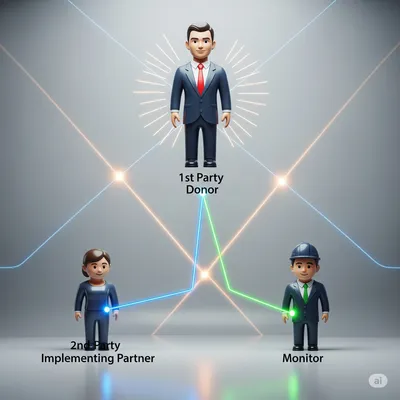
Agency Theory in Monitoring - Redefining the Third-Party Monitor Role
June 28, 2024
Uncover why "Third-Party Monitoring" is a misnomer. Learn how framing monitors as "second-party agents" acting on behalf of a principal leads to clearer mandates, improved stakeholder management, and sharper accountability in development and humanitarian sectors.

Monolithic vs. Modular Architecture - Strategic Frameworks for Public Finance
June 25, 2024
Explore the strategic choice between monolithic and modular architectures for public financial management (PFM) systems. Learn why a federated, API-driven approach offers greater agility, resilience, and better governance for modern states.

Institutional Failure Analysis - Why Capacity Building Stalls in Fragile States
October 11, 2023
Explore why capable individuals in fragile and conflict-affected states struggle to translate good intentions into positive outcomes due to systemic issues and misaligned incentives

Functional Grievance Redress Mechanisms: Verifying Accountability Metrics
November 15, 2022
Learn how to reliably verify a Grievance Redress Mechanism GRM s functionality by assessing its accessibility perceived fairness and effectiveness in leading to resolution ensuring true project accountability

Dual-Mandate Design: Humanitarian Interventions that Reinforce State Systems
September 21, 2021
Learn how to design humanitarian aid that simultaneously builds local capacity rather than bypassing it. Explore a "systems-aware" framework for responsible response in protracted crises, fostering long-term institutional strengthening.

ESG Integration and Local Economic Impact in Frontier Markets
January 25, 2021
Learn about Abyrints integrated CSR approach prioritizing local sourcing ethical supply chains and investing in local professional ecosystems to create positive sustainable impact

Financial Verification as a Driver for Systemic PFM Reform: A Case Analysis
July 29, 2019
Discover a case study where routine financial verification evolved into system-wide reform for a national health program. Learn how data-driven diagnostics and collaborative root cause analysis led to sustainable process improvements.
Discuss Institutional Reform
Contact the partners for a confidential discussion regarding functional reviews and capacity building.
Contact Partners